


Each month, billing teams face the same challenge of transforming raw operational data into accurate, timely bills. They need correct numbers to ensure satisfied customers and reliable revenue, but they’ll never achieve those goals without data integrity.
When meter readings, customer records and service addresses don’t match, errors slip into the billing cycle. Those mistakes lead to delayed payments, frustrated customers and preventable revenue loss. Nearly half of customers report confusion about their utility bills, often due to these underlying data issues.
Three specific failure points drive most of these problems — and one automated solution can eliminate them all.
Most billing errors stem from three specific failure points in the typical utility workflow, which slowly erode revenue and efficiency without triggering immediate alarms. You can’t fix these breakdowns until you pinpoint where they are.
Many municipalities still rely on outdated processes designed for a pre-digital era. Using spreadsheet-based billing systems creates vulnerabilities at every turn. Manual workflows that seemed efficient 20 years ago now represent significant liabilities in an era of automated meter infrastructure and real-time data.
Manual data reentry is the classic “garbage-in, garbage-out” problem that guarantees inefficiencies over time. Even the most diligent, experienced employee will eventually make a typo or transposition error. A “3” becomes an “8.” A decimal point shifts one place to the left, turning a reading of 12.45 into 1.245.
These mistakes will compound quickly, triggering inaccuracies and customer confusion that delay revenue collection. Though fixing errors often costs more than preventing them, many utilities are still reluctant to change, even when the math plainly shows that manual touch points invite errors and automation delivers an immediate return on investment.
AMI data validation depends on seamless communication between systems. When the customer information system and the meter data from AMI or AMR systems operate separately, they quickly fall out of sync. This disconnection may create numerous problems for the integrity of utility data.
Move-ins and move-outs are typical examples. If your staff doesn’t update the CIS when a customer relocates, the next bill you send will go to the wrong person. Meter swaps create similar issues. When a team replaces a meter at a customer’s home, but fails to enter the new meter ID in the billing system, the result is usage data that doesn’t match the account.
These slips will become routine without proper billing software integration.
The stakes for poor data quality extend beyond operational headaches. Bad customer experiences cost approximately $3 trillion in sales globally. For example, incorrect address data directly impacts revenue cycles by leading to delayed payments and revenue gaps.
Confused customers call because they never received their bills, forcing staff to spend time tracking down current addresses and reissuing statements.
Address errors represent a measurable hit to your bottom line. The solution is Coding Accuracy Support System certification, the industry-standard method for ensuring mailability. CASS validates addresses against USPS records, thus eliminating address-related billing delays.
Utilities that ignore data integrity issues risk losing revenue and customer trust. Luckily, you won’t have to work harder to catch mistakes if you switch to an automated system that prevents them from happening.
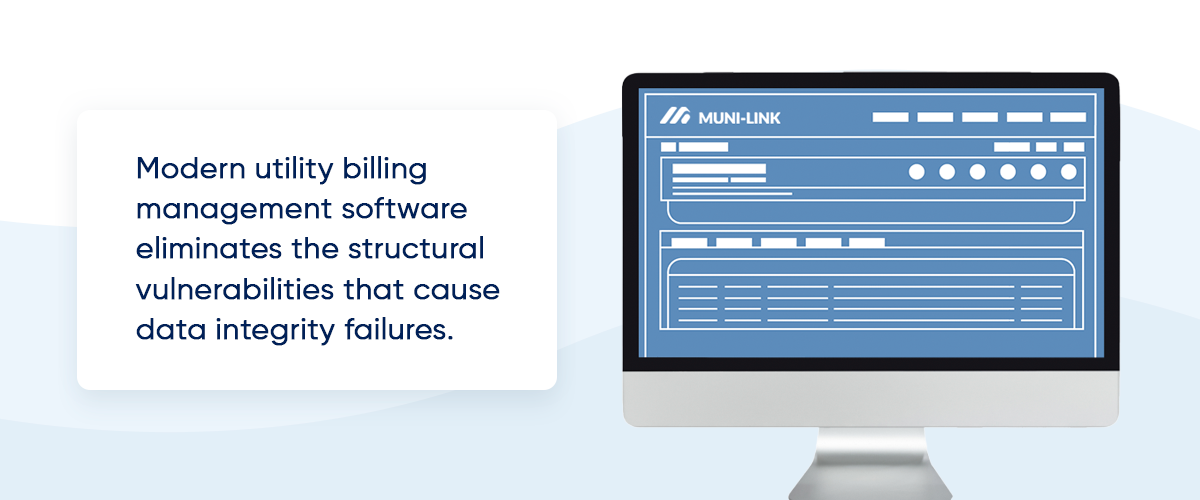
Modern utility billing management software eliminates the structural vulnerabilities that cause data integrity failures. Automated workflows reduce errors and eradicate entire categories of failure points by removing manual intervention from the process.
A modern, unified CIS is the central hub for billing data, a single source of truth that breaks down silos. When all information lives in one integrated system, consistency becomes automatic rather than aspirational.
An integrated CIS delivers measurable improvements across your billing operation.
Choosing the best CIS requires careful consideration of integration capabilities. Not all systems can handle the complex data flows that modern utility billing demands.
Finance directors prioritize accountability. When revenue discrepancies appear, they’ll always want to know who changed what and when. While spreadsheets can’t answer that question, a professional CIS creates a verifiable log of every change.
This audit trail delivers critical value for any utility that takes their bottom line seriously.
Pre-bill validation is the ultimate safety net that turns reactive damage control into proactive quality assurance.
Before finalizing the billing run, the system automatically identifies issues that would otherwise lead to customer complaints and delayed revenue. Automated validation provides comprehensive error detection.
Instead of discovering errors after customers call to complain, your team can catch them before sending bills. The resulting time savings and revenue protection will be invaluable.
Manual processes are a liability. They allow errors, delay revenue and erode customer trust. Instead of hiring new team members, why not implement an automated CIS that validates data for you?
The benefits are measurable — protected revenue, improved customer satisfaction and reduced manual work for billing staff. Muni-Link’s cloud-based utility billing software integration works without the silos and manual reentry that cause billing errors in the first place.
Our integrated CIS automatically validates meter data, maintains CASS-certified address records and creates an audit trail for every change. The result is accurate bills, faster payments and fewer customer complaints.
Imagine your billing team focusing on managing exceptions instead of hunting for typos. Request your personalized demo to see pre-bill validation in action or contact us today to discuss your current billing challenges.